From Forest to Home
Forests for the Future, Episode 9. Following timber from standing tree to finished product: harvesting, transport, sawmills, construction, furniture and renewable materials.
Out of the forest
A harvester fells, de-limbs and cuts each stem to length, measuring as it goes. A forwarder carries the logs to the roadside, sorted by product: sawlog, pallet wood, stakes, pulp. Nothing much is wasted; even the brash goes back on the ground to protect the soil.
From the roadside, timber lorries take it to the mill, often less than a hundred kilometres away. Short journeys matter as much to the carbon figure as anything that happens in the forest.
Timber is the only building material we can grow, and the only one that stores carbon while it waits.
Through the mill
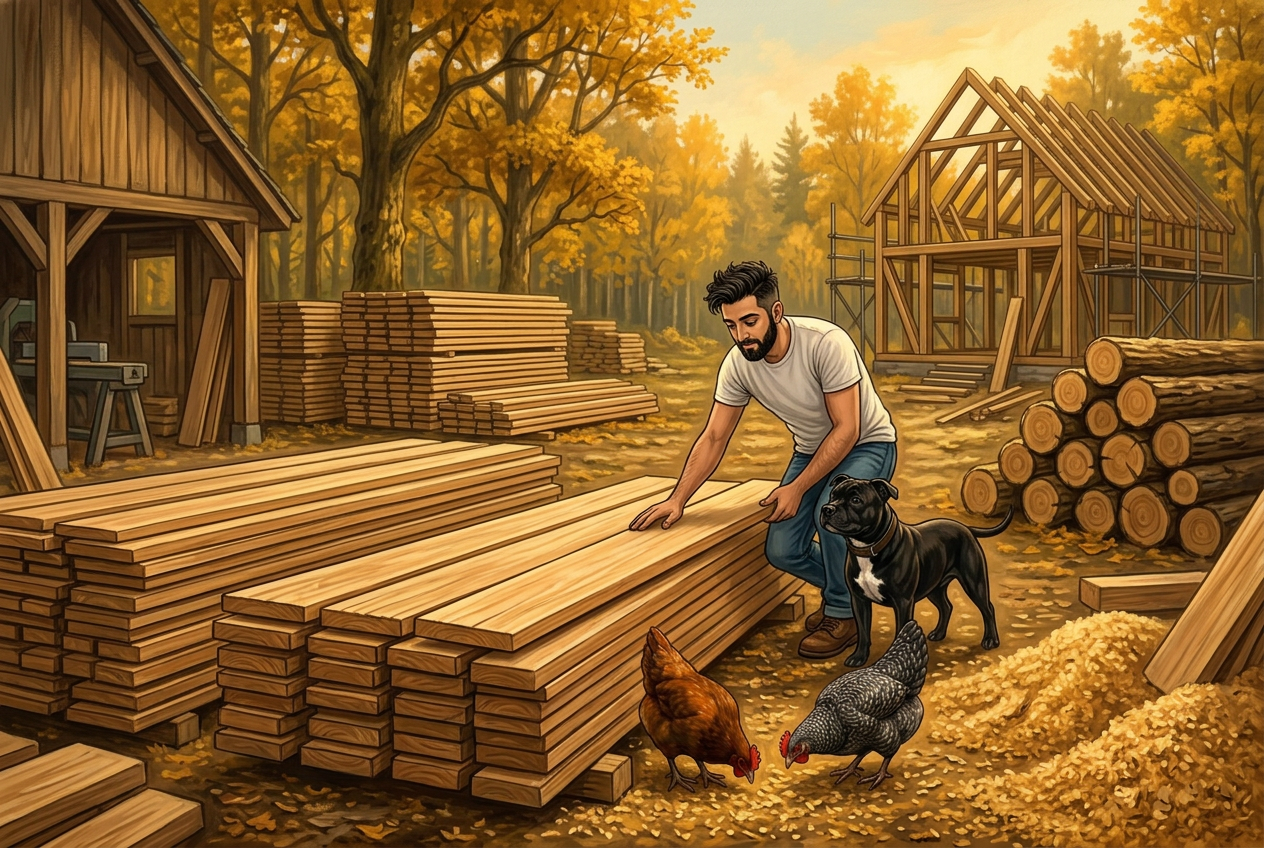
At the sawmill each log is scanned and cut to take the most value out of it. Boards are kiln dried, planed, strength graded and stamped. Sawdust and offcuts become board products, animal bedding or fuel.
The grading stamp is what allows a piece of Irish spruce to be used in a structural frame. It is the reason a tree from a wet hillside can be trusted to hold up a roof.
Into the house
Then it becomes ordinary: a wall frame, a roof truss, a floor, a stair, a kitchen table, a fence, a garden bench. The carbon the tree took out of the air stays locked in the board for as long as the building stands.
And back in the forest, the next crop is already growing on the same ground.
Most people never meet the forest. They live inside it.